
FIX & Execution · Capitoline Technology Team · 9 min read
If you run a boutique hedge fund, a small trading desk, or a growing asset management firm, there is a good chance you have experienced some version of this conversation.
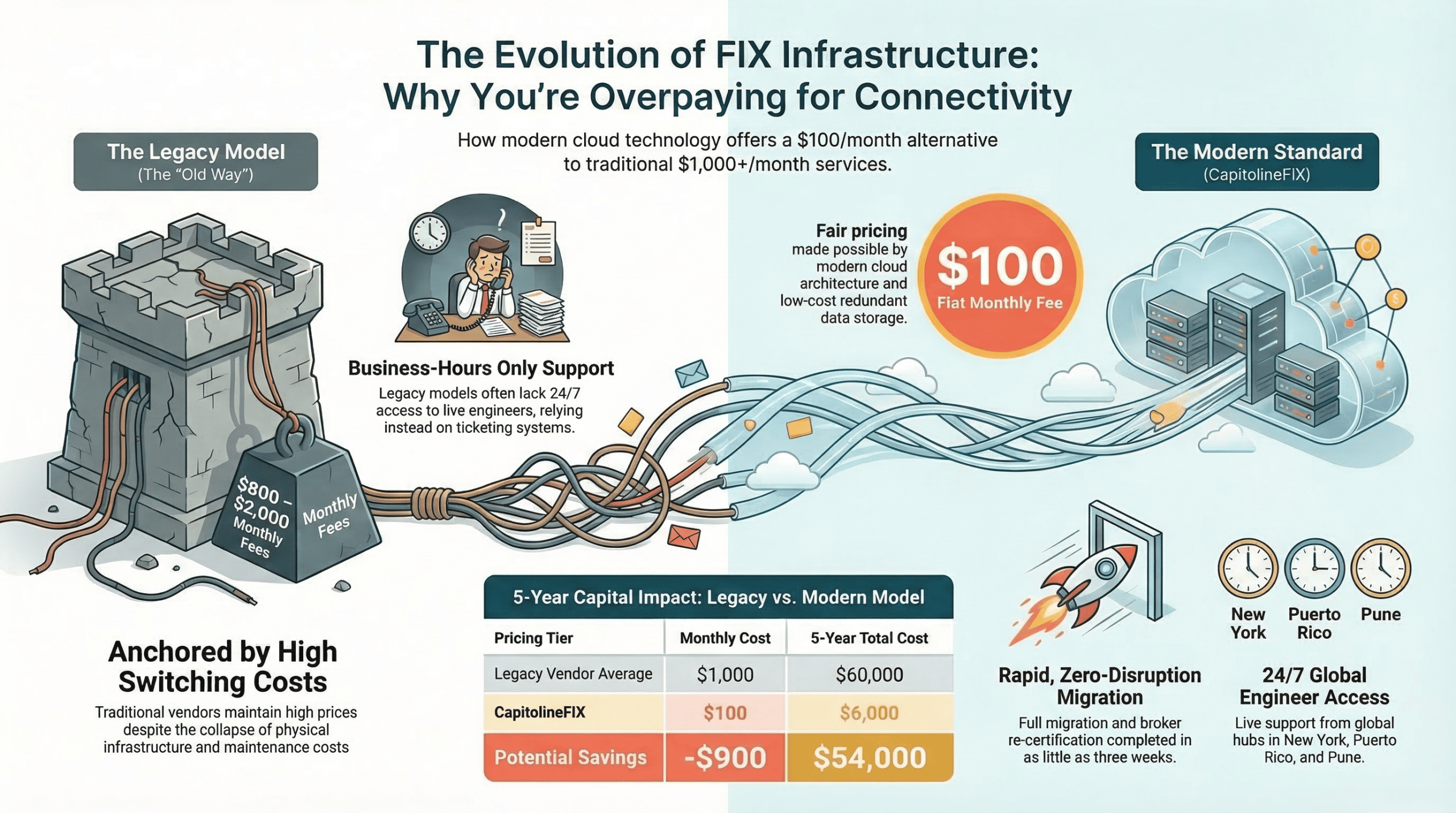
You call a FIX connectivity vendor to ask about pricing. The sales representative quotes you somewhere between $800 and $2,000 per month. You ask what that includes. They mention real-time trade capture, maybe historical data access, perhaps a support line — business hours only. You do the mental arithmetic and realise you are paying more for FIX infrastructure than you are for several other mission-critical systems combined.
You accept it, because you assume this is simply what FIX costs.
It is not. And this article is going to explain why — starting with what FIX protocol actually is, how the legacy pricing model came to be, what FIX infrastructure genuinely costs to operate, and why $100 per month is not a compromise. It is what fair pricing looks like.
What Is FIX Protocol and Why Does Every Trading Desk Need It?
FIX stands for Financial Information eXchange. It is a standardised messaging protocol — essentially a shared language — that financial institutions use to communicate trade orders, executions, and related information with one another electronically.
First developed in 1992 as a bilateral agreement between Fidelity Investments and Salomon Brothers, FIX has since become the universal standard for institutional trading communication worldwide. If you are sending an order to a broker, receiving an execution report, cancelling a trade, or managing a position with a prime broker or exchange, you are almost certainly doing it over FIX.
This is not optional infrastructure for institutional traders. FIX connectivity is as fundamental to running a trading desk as having a bank account is to running a business. Without it, you cannot participate in the institutional market ecosystem.
The Three Things FIX Infrastructure Must Do
At its core, FIX infrastructure has three jobs:
1. Capture trades in real time. Every order sent and every execution received needs to be captured the moment it happens — with accurate timestamps, complete message data, and zero dropped messages. This is the live plumbing of your trading operation.
2. Store historical trade data. Regulators, compliance teams, risk managers, and portfolio analysts all need to access historical trade records. A FIX platform must retain complete message logs — going back months or years — and make them searchable and retrievable on demand.
3. Manage broker sessions reliably. A trading desk typically connects to multiple brokers, prime brokers, and exchanges simultaneously. FIX infrastructure must manage all of these sessions — handling connection drops, heartbeat monitoring, message sequencing, and re-transmission — without requiring manual intervention.
That is the full job description. It is important to keep this in mind when evaluating what you are actually paying for.
How Legacy FIX Vendors Arrived at $1,000/Month
To understand why FIX infrastructure became so expensive, you need to understand the era in which the legacy pricing model was built.
In the early 2000s, deploying FIX infrastructure required significant physical investment. Servers needed to be purchased, racked, and maintained on-premises or in expensive co-location facilities. Software licences were substantial. Integration work required specialist engineers who commanded premium day rates. Ongoing maintenance meant dedicated headcount. Support required a team available around the clock.
In that environment, charging $1,000 to $2,000 per month for FIX infrastructure was not entirely unreasonable. The vendors had genuine costs to cover, and the market accepted the pricing because there were no alternatives.
The World Changed. The Pricing Did Not.
Cloud computing changed the economics of running software infrastructure so dramatically that the old cost structures became largely obsolete. The cost of running reliable, redundant server infrastructure dropped by an order of magnitude. Software deployment became faster and cheaper. Monitoring and alerting tools became commoditised. Global connectivity became affordable.
The capital and operational expense that once justified four-figure monthly FIX fees collapsed. But the pricing did not follow.
Legacy FIX vendors found themselves in a comfortable position. Their customers had integrated their systems, trained their teams, and taken on the operational risk of switching providers. The switching cost — in time, technical effort, and potential trading disruption — was a powerful deterrent to shopping around. So prices stayed high. Support got commoditised. And the gap between what FIX infrastructure genuinely costs to deliver and what vendors were charging it grew wider every year.
The result is an industry where a boutique fund with $50 million under management pays the same FIX infrastructure bill as a firm ten times its size — not because the economics justify it, but because no one had rebuilt the pricing model from the ground up.
What FIX Infrastructure Actually Costs to Operate Today
Let’s be transparent about the real cost components of running institutional-grade FIX trade capture in 2024.
Cloud infrastructure. A properly redundant, high-availability server environment capable of handling FIX message traffic for a typical institutional trading desk costs a fraction of what it did a decade ago. Modern cloud providers offer reliable, scalable infrastructure at prices that would have seemed impossible in the co-location era.
Data storage. Storing years of FIX message history is not expensive. Modern object storage is remarkably cheap per gigabyte, and FIX messages — while numerous — are compact text-based records. An entire year of FIX message history for a typical trading desk occupies far less storage than you might expect.
Network connectivity. Global low-latency connectivity to major financial centres is available at commodity pricing from multiple providers. The days of paying premium rates for financial-grade network access are largely over.
Engineering and support. This is the genuine cost — skilled engineers who understand FIX protocol deeply, can manage session certification with counterparties, troubleshoot connectivity issues, and provide 24/7 support. This is where the real value is, and where Capitoline concentrates its investment.
When you add these components together honestly — cloud infrastructure, storage, connectivity, and a lean, expert engineering team — the economics of delivering high-quality FIX infrastructure at $100 per month are not only possible. They are straightforward.
The legacy vendors are not charging more because their costs demand it. They are charging more because they can.
What $100/Month Actually Gets You With CapitolineFIX
CapitolineFIX was built from the ground up with a single question in mind: what does genuinely institutional-grade FIX infrastructure look like when you design it without the legacy cost structure?
The answer, at $100 per month flat, includes everything a professional trading desk needs.
Real-Time Trade Capture
Every FIX message — new orders, execution reports, order cancellations, amendments, rejections — is captured in real time with sub-millisecond latency. The capture pipeline is designed to handle the message volumes of institutional trading desks without dropped messages or sequencing errors, regardless of market conditions or trading volume spikes.
Complete Historical Archive
Every message is stored in a fully searchable historical archive, accessible from day one of your subscription. There are no additional fees for historical data access, no tiered storage pricing, and no limits on how far back you can query. Compliance teams, risk managers, and portfolio analysts all get the data they need without navigating a pricing structure designed to charge extra for everything.
Multi-Broker Session Management
CapitolineFIX manages simultaneous FIX sessions with multiple brokers, prime brokers, and exchanges. Session health monitoring, automatic reconnection, heartbeat management, and message re-transmission are all handled without manual intervention. Adding a new broker counterparty — including the FIX certification process — is managed by the Capitoline team.
FIX 4.2, 4.4, and 5.0 Compatibility
The majority of institutional FIX sessions operate on FIX 4.2 or 4.4 — the two most widely deployed versions in the industry. CapitolineFIX supports all three major versions, ensuring compatibility with every counterparty regardless of which version they have standardised on. FIX 4.4 is the recommended default for new sessions.
24/7 Live Engineer Support — Included
This is where CapitolineFIX is fundamentally different from most alternatives at any price point. The $100 monthly fee includes round-the-clock access to live Capitoline engineers — not a ticketing system, not a chatbot, and not a support team that operates on business hours while your trading desk runs around the clock.
Financial markets do not keep business hours. Trading infrastructure issues do not wait until Monday morning. The support model reflects that reality.
Capitoline operates across three global hubs — New York, Puerto Rico, and Pune — specifically to ensure that live engineering support is available across all market time zones without gaps.
Full Compliance Audit Trail
Every FIX message is time-stamped, sequenced, and stored in an immutable audit log that satisfies regulatory requirements for trade record-keeping. Whether your compliance team needs to respond to a regulatory enquiry, conduct an internal review, or demonstrate best execution, the complete record is there — searchable, exportable, and defensible.
Common Objections — Answered
This is the most common reaction, and it is entirely understandable given the pricing expectations the legacy vendors have set. The honest answer is that nothing is missing from the core FIX infrastructure offering. Real-time capture, historical archive, multi-broker sessions, FIX 4.2/4.4/5.0 support, and 24/7 live engineer support are all included.
What is different is the business model. CapitolineFIX was built on modern cloud infrastructure from day one — not migrated from legacy on-premises architecture. The cost structure reflects the actual economics of running this infrastructure today, not the economics of 2005.
This is the concern legacy vendors are counting on. The reality is that Capitoline manages the entire migration process — including re-certification of all existing broker FIX sessions — with the explicit goal of zero disruption to live trading. Clients have gone live on CapitolineFIX in as little as three weeks from the start of the engagement, with no missed trades and no session downtime during the transition.
Loyalty to a vendor that has not evolved its pricing in a decade is not an asset — it is a cost. If your current FIX provider is charging $800, $1,000, or $1,500 per month and delivering the same core functionality that CapitolineFIX provides for $100, that difference compounds significantly over time. Over five years, the gap between $100/month and $1,000/month is $54,000 — capital that could be deployed elsewhere in your business.
Who CapitolineFIX Is Built For
CapitolineFIX is particularly well suited to three types of institutional market participants.
Boutique and emerging hedge funds that need institutional-grade FIX infrastructure from day one but cannot justify the legacy pricing model on a lean operational budget. Getting FIX right from the start — rather than using a cheaper workaround and migrating later — is always the right call.
Established funds reviewing their technology costs who have been paying legacy vendor prices without questioning whether the market has moved on. In most cases, it has.
Trading desks adding new broker relationships who need to expand their FIX session coverage without paying per-session add-on fees that legacy vendors typically charge on top of their base monthly rate.
CapitolineFIX is not built for firms that need bespoke enterprise customisation or white-labelled infrastructure as part of a larger technology platform. For those requirements, Capitoline’s consulting and operations team can discuss a tailored engagement.
The Broader Point About Capital Markets Technology Pricing
The FIX infrastructure pricing problem is not unique. It is representative of a broader pattern in capital markets technology where legacy vendors — insulated by switching costs and institutional inertia — have maintained price points that bear no relationship to the actual cost of delivery in a modern technology environment.
The same pattern exists in market data, order management systems, risk platforms, and portfolio analytics. In each case, the economics of cloud infrastructure, modern software engineering, and global connectivity have dramatically reduced the cost of delivery. In each case, pricing has been slow to follow.
At Capitoline Global Group, the approach is to build every product — CapitolineFIX, Alpha News Aggregator, Alpha Robo Advisor — on the actual economics of what it costs to deliver them today, not on what the market has historically accepted. That means $100/month for institutional FIX trade capture. It means sub-second news intelligence. It means AI-driven portfolio management that is accessible to wealth managers at any scale.
The question worth asking about every capital markets technology line item on your budget is simple: does this price reflect what it costs to deliver today, or does it reflect what someone decided to charge a decade ago and never revisited?
For FIX infrastructure, the answer is usually the latter.
Ready to See What $100/Month Looks Like in Practice?
If you are currently paying more than $100/month for FIX trade capture — or if you are evaluating FIX infrastructure for the first time — we are happy to walk you through CapitolineFIX with a live demonstration.
There is no obligation and no sales pressure. Just a clear look at what institutional-grade FIX infrastructure looks like when it is priced honestly.