
For most of its early history, decentralized finance occupied a space that institutional capital markets could safely observe from a distance. Unregulated, operationally immature, and associated primarily with speculative retail activity, DeFi represented a technological curiosity – intellectually interesting but practically irrelevant to the risk management and compliance frameworks that govern institutional finance.
That description no longer fits 2026. The DeFi landscape has undergone structural transformation that changes the conversation fundamentally. The protocols that have survived and scaled are those that prioritized security auditability, governance transparency, and composability with institutional-grade custody frameworks. The question facing institutional finance teams today isn’t whether DeFi is relevant. It’s how to engage with it in a way that’s operationally sound, compliance-defensible, and strategically coherent.
WHAT HAS ACTUALLY CHANGED IN DEFI INFRASTRUCTURE
The meaningful shifts in DeFi’s institutional viability have been structural rather than speculative. The developments that matter most for institutional engagement are precise and measurable:
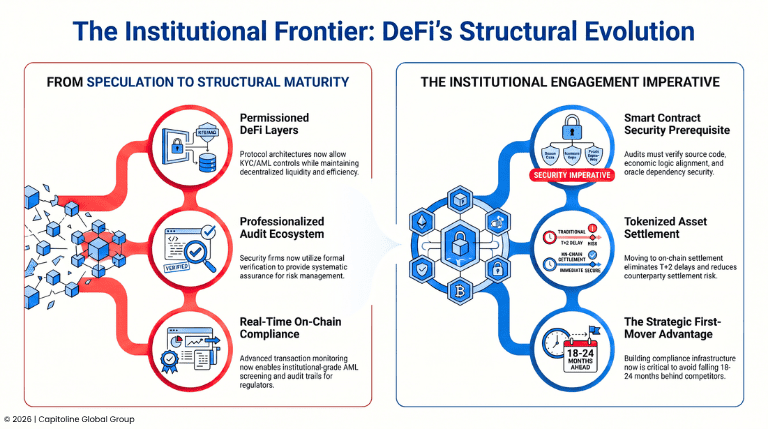
Permissioned DeFi layers have emerged as protocol architectures that maintain the efficiency and composability of decentralized finance while implementing KYC/AML controls at the participant level. This allows institutions to access DeFi liquidity pools within a compliance perimeter rather than having to choose between full transparency and full anonymity.
Smart contract audit maturity has transformed from an emerging practice to an established discipline. Security firms now apply formal verification methods to critical protocol code, providing a level of assurance that institutional risk management frameworks can evaluate systematically rather than qualitatively. The audit ecosystem has professionalized sufficiently that institutions can have confidence in the security analysis being performed on code they’re about to deploy capital to.
On-chain analytics and transaction monitoring have advanced to the point where institutional-grade AML screening of DeFi activity is operationally feasible. The ability to monitor blockchain transactions for compliance purposes – identifying suspicious patterns, screening wallet addresses against sanctions lists, and producing audit trails for regulators – has moved from theoretically possible to practically implemented.
Regulatory engagement has occurred across multiple jurisdictions. The US, EU, and Singapore have all advanced frameworks that explicitly address DeFi activity, providing at least a partial legal architecture for institutional participation. This regulatory clarity, while not complete, has reduced the legal uncertainty that previously made institutional DeFi engagement unacceptably risky.
THE INSTITUTIONAL OPPORTUNITY SET IN DEFI
For institutions that have built the compliance and operational infrastructure to engage with DeFi, the opportunity set is meaningfully different from what retail participants access. The strategic advantages are real:
On-chain liquidity provision to permissioned AMM pools generates fee income that is structurally different from traditional fixed income. The yield profile is distinct, the risk characteristics are different, and when properly implemented, it represents genuine portfolio diversification for institutions that understand what they’re deploying capital to.
Tokenized asset settlement enables near-instantaneous settlement of tokenized traditional assets – equities, bonds, real estate interests – eliminating the T+2 settlement delays and counterparty settlement risk that persist in traditional market structure. For institutions managing large volumes of transactions, this settlement speed differential translates to operational efficiency and reduced capital requirements.
Treasury management applications have begun to emerge where institutions use permissioned DeFi protocols for short-duration liquidity management. The ability to access yields on stablecoin and tokenized money market positions that compete with traditional treasury instruments is meaningful for institutions with substantial cash positions.
THE SMART CONTRACT SECURITY IMPERATIVE
Any institutional engagement with DeFi infrastructure runs directly through smart contract security. The history of DeFi includes numerous protocol exploits, and post-mortem analysis consistently reveals that the majority were attributable to logic vulnerabilities or source code loopholes that rigorous pre-deployment auditing would have identified.
For institutional participants, this means smart contract audit capability is not optional infrastructure. It’s the absolute prerequisite for any DeFi engagement. The audit process must be comprehensive: covering not just the code itself but the economic logic of the protocol, the governance mechanisms, and the oracle dependencies that create external attack surfaces.
The specific audit requirements that institutions need to enforce:
Code-level security review that examines the smart contract source code for standard vulnerability classes: reentrancy issues, integer overflow/underflow, unchecked external calls, and improper access control. Auditors apply static analysis tools, manual code review, and in the most rigorous cases, formal verification methods.
Economic logic verification that ensures the protocol’s economic incentives are aligned correctly – that the rewards mechanism doesn’t create arbitrage loops, that liquidation mechanics function as intended under stress conditions, and that governance doesn’t create perverse incentives for oracle manipulation.
Oracle dependency analysis that identifies every external data feed the protocol depends on, assesses the security of those feeds, and evaluates what happens if those feeds provide incorrect data. This is a frequent source of protocol failures that code audits alone won’t catch.
Governance security assessment that reviews the voting mechanisms, proposal execution, and upgrade paths to ensure that protocol changes can’t be executed through governance attacks or vote manipulation.
Institutions engaging with DeFi without access to this audit infrastructure are taking on a category of technical risk that their existing risk frameworks almost certainly don’t account for adequately. The reputational and capital costs of being exposed to a protocol hack are high enough that institutional investors have no choice but to treat audit infrastructure as a prerequisite.
BUILDING THE COMPLIANCE ARCHITECTURE FOR DEFI
The compliance architecture required for institutional DeFi participation is more complex than for traditional digital asset investment. On-chain activity creates permanent, public audit trails – which is both an advantage for internal compliance monitoring and a constraint on how activity is structured.
Counterparty screening requires that DeFi protocols supporting institutional participation provide mechanisms for screening counterparty wallet addresses against sanctions lists and adverse media databases before transactions are executed. This isn’t optional for institutions subject to OFAC sanctions compliance and AML requirements.
Transaction monitoring involves ongoing surveillance of on-chain activity for unusual patterns, large position movements, and potential market manipulation. This requires adapting traditional surveillance frameworks to the specific characteristics of on-chain transaction data, which is structurally different from traditional market activity.
Reporting and documentation infrastructure must enable institutions to produce transaction records in formats compatible with existing regulatory reporting frameworks. This covers cost basis calculation, gain/loss realization for tax purposes, and income attribution for DeFi positions.
Client communication requires that institutions operating DeFi positions have the documentation and transparency infrastructure to explain to stakeholders exactly what the positions are, what the risks are, and how they’re monitoring them. Institutions managing assets on behalf of others need to be able to provide this with the same clarity they provide for traditional positions.
THE REGULATORY TRAJECTORY
The institutions that will benefit most from DeFi’s continued institutional maturation are those building the operational and compliance infrastructure now, rather than waiting for every regulatory question to be definitively answered before beginning.
The regulatory trajectory across major jurisdictions is toward engaged oversight rather than prohibition. This doesn’t mean every jurisdiction has finalized its DeFi regulatory framework – many critical details remain to be worked out. But the direction of travel is clear: regulators are moving toward engagement with the DeFi ecosystem rather than attempts to suppress it through prohibition.
Institutions that have built compliance frameworks for DeFi participation will be positioned to scale that participation as the regulatory environment clarifies. Those waiting for complete regulatory certainty before building will find themselves 18 to 24 months behind a competitive set that moved constructively while they were waiting.
THE STRATEGIC POSITIONING QUESTION
For institutional finance teams, the strategic question isn’t whether DeFi will eventually be relevant to institutional capital allocation. It already is for those positioned to engage. The question is how quickly your institution builds the infrastructure to participate in that opportunity set.
The technology exists. The audit ecosystem exists. The regulatory frameworks are forming. The only remaining variable is institutional decision-making about when to invest in the operational, compliance, and risk infrastructure required to engage seriously.
The timeline for this decision is compressed. The firms that wait for absolute clarity before moving will be competing for opportunities in a market where early movers have already established relationships, built expertise, and captured the highest-return positions. In DeFi, as in most markets, timing matters.