
Diversity in financial technology leadership has long been dominated by normative arguments rather than concrete business cases. The evidence has been accumulating for over a decade, and it points consistently in one direction: diverse leadership structures produce measurably better risk-adjusted organizational outcomes in the specific domains that matter most in financial technology.
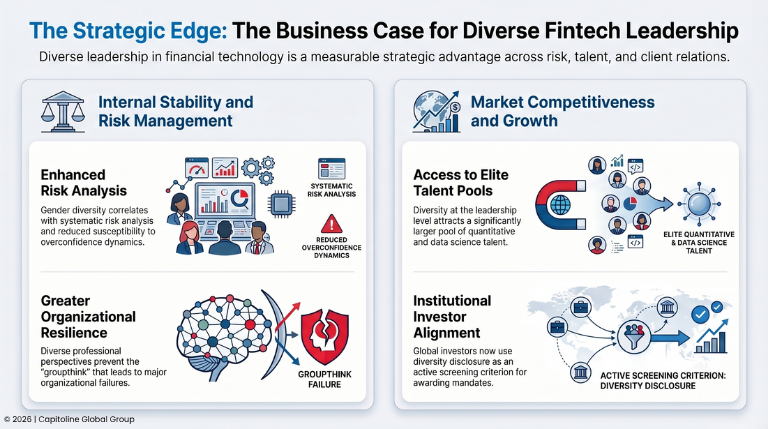
The risk management dimension provides the most compelling evidence. Studies across banking, asset management, and trading operations have consistently found that leadership teams with meaningful gender diversity exhibit different risk-taking patterns – specifically, a tendency toward more systematic risk analysis and less susceptibility to the overconfidence dynamics that produce concentrated, unhedged exposures.
In an industry where the consequences of risk management failure are measured in billions, this isn’t marginal. It represents a structural difference in organizational risk culture that has demonstrable performance implications across market cycles.
The talent acquisition reality is equally concrete. The competition for quantitative and technical talent in financial technology is as intense as it has ever been. Firms that have built reputations for genuine diversity at the leadership level access a materially larger talent pool than those that haven’t. This is particularly acute for data science and quantitative talent, where the pipeline of women has grown significantly while the number of employers competing effectively for that talent has not kept pace.
The client and counterparty relationships dimension has moved from passive preference to active screening criteria. A growing number of institutional investors have implemented formal requirements for diversity disclosure from investment managers seeking mandates and informal preferences that influence manager selection even where formal requirements don’t yet exist.
The organizational resilience benefit is less immediately visible but equally important. Leadership teams that represent genuinely different professional perspectives and problem-solving approaches are less susceptible to the groupthink dynamics that produce the most consequential organizational failures in financial services.
The competitive conclusion is clear: diverse leadership in financial technology is not a social program running parallel to the business. When implemented with genuine organizational commitment, it is a source of competitive differentiation in talent acquisition, risk management quality, client relationships, and strategic decision-making.