The integration of blockchain technology into traditional financial operations is no longer a future possibility it’s an operational reality that sophisticated firms are actively implementing. The question is no longer whether blockchain will integrate with traditional finance, but how quickly, in what forms, and for which use cases.
The integration challenge is significant, however. Blockchain systems operate on different principles than traditional financial infrastructure. They settle differently, they maintain records differently, they handle custody differently, they interface with regulatory systems differently. Building operational infrastructure that bridges these two worlds requires understanding both sides and designing systems that can operate coherently with both.
THE STRUCTURAL DIFFERENCES BETWEEN BLOCKCHAIN AND TRADITIONAL SETTLEMENT
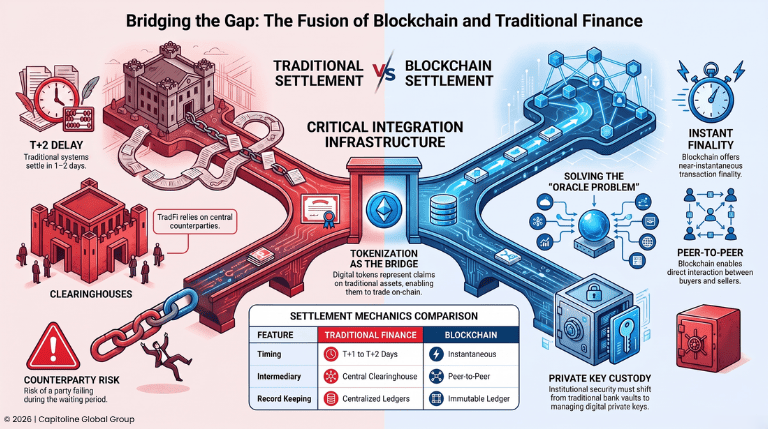
The most fundamental difference between blockchain and traditional financial settlement is timing. Traditional settlement takes time: equities settle T+2 (two business days after trade), bonds settle T+1, some OTC derivatives settle even more slowly. During this settlement period, counterparty risk exists either party could fail before settlement occurs.
Blockchain settlement is nearly instantaneous. Once a transaction is recorded on the blockchain, it’s final. There’s no T+2 period, no counterparty risk during settlement, no possibility of failed settlement. This is a fundamental structural difference with enormous implications for custody, capital efficiency, and operational risk.
Traditional settlement requires a clearing system to manage the central counterparty risk between buyer and seller. The buyer and seller don’t interact directly; instead, each has a relationship with the clearinghouse. Blockchain settlement is peer-to-peer: the buyer and seller interact directly, with settlement occurring on the blockchain.
These differences create operational challenges: how do you interface a blockchain-native settlement process with traditional custody systems? How do you manage custody of blockchain-settled assets in a way that satisfies regulatory requirements and institutional risk standards?
TOKENIZATION: THE BRIDGE BETWEEN SYSTEMS
Tokenization—representing traditional financial assets as blockchain-based tokens—provides the bridge that makes integration feasible. A tokenized equity can be settled on blockchain (fast, peer-to-peer, final) while still representing a claim on the underlying company shares. A tokenized bond can be settled on blockchain while still being a legal claim on the bond’s cash flows.
The operational challenge is ensuring that the blockchain token actually represents what it claims to represent. If a tokenized share of stock is issued on Ethereum, what prevents someone from issuing a second token claiming to represent the same share? How is the token holder’s claim enforced if the company issues additional tokens? How do corporate actions (dividends, splits) propagate to the token holders?
These questions have answers, but the answers require operational infrastructure: asset registers that track which tokens represent which underlying assets, legal frameworks that give tokens enforceable claims, and mechanisms to ensure that corporate actions propagate properly.
Custody of tokenized assets creates specific challenges. The token itself is a digital asset that exists on a blockchain. Custody means managing the private key that controls the token. Traditional custody infrastructure – banks, custodians, clearinghouses – isn’t designed to manage blockchain private keys. New custody infrastructure is emerging, but it requires different security model than traditional custody.
THE ORACLE PROBLEM IN BLOCKCHAIN INTEGRATION
One of the most significant operational challenges in blockchain integration is the oracle problem: how do blockchain systems access accurate information about the outside world?
A smart contract that’s supposed to pay out based on the price of an asset needs to know what the current price is. The blockchain itself doesn’t have access to real-time market data. It needs an oracle – an external service that provides that data. If the oracle provides incorrect data, the smart contract operates on that incorrect information.
This creates a vulnerability: if you can manipulate the oracle data, you can manipulate the smart contract’s behavior. This is a known attack vector in blockchain systems. Protecting against oracle manipulation requires:
Using multiple independent oracle providers: if three different price feeds are consulted and consensus is required, one corrupted oracle can’t manipulate the outcome.
Using decentralized oracle networks where data is provided by many independent participants rather than a single centralized service.
Designing smart contracts to detect and handle oracle failures gracefully.
For institutional use cases, this oracle infrastructure is critical. If a smart contract controlling billions in capital is vulnerable to oracle manipulation, institutions won’t use it.
REGULATORY REPORTING AND COMPLIANCE
Blockchain systems maintain permanent, immutable records of all transactions. From a compliance perspective, this is excellent: there’s a complete audit trail that can’t be altered or deleted. From an operational perspective, it creates challenges.
A transaction that’s recorded on a blockchain can’t be reversed. If a transaction is later determined to be erroneous, you can’t simply delete it. You have to issue an offsetting transaction. Regulatory reporting systems need to be designed to handle this blockchain-specific characteristic.
Sanctions compliance becomes more complex. If a blockchain address is determined to be controlled by a sanctioned party, what happens to tokens that were previously transferred to that address? In traditional systems, the transaction would be reversed. In blockchain systems, it can’t be reversed, but you can prevent future transactions from that address.
Tax reporting needs to account for the fact that blockchain transactions are final and immutable. The cost basis of an asset, the dates of purchase and sale, the amounts involved – all of these need to be tracked carefully for tax purposes, and they can’t be changed retroactively.
MARKET INFRASTRUCTURE FOR BLOCKCHAIN-BASED ASSETS
As blockchain assets become more common, market infrastructure is developing to support trading and custody of those assets. Blockchain-native exchanges allow direct trading of tokens. Blockchain-native custodians provide secure custody of blockchain assets. Clearing and settlement operate on-chain.
The challenge is that this blockchain-native infrastructure is separate from traditional market infrastructure. A trader with positions in both traditional equities and tokenized equities needs to manage positions in two separate market infrastructures with different operational procedures, different risk management frameworks, different clearing procedures.
Integration infrastructure is emerging: bridges between blockchains, bridges between blockchain and traditional systems, custody providers that support both traditional and blockchain assets. But this is an area of active development rather than established practice.
BUILDING INSTITUTIONAL BLOCKCHAIN OPERATIONS
For institutions seriously exploring blockchain integration, the infrastructure requirements include:
Custody infrastructure for blockchain assets: secure storage of private keys, multi-signature arrangements, disaster recovery systems.
Trading infrastructure: connections to blockchain-native exchanges or decentralized finance protocols, order execution systems, trade capture and reporting.
Settlement infrastructure: integration of blockchain settlement with existing settlement systems, reconciliation procedures, corporate action handling.
Compliance and reporting: transaction monitoring for sanctions compliance, tax reporting systems, regulatory reporting systems.
Risk management: real-time position tracking across traditional and blockchain assets, risk aggregation, stress testing.
THE TIMELINE AND COMPETITIVE POSITIONING
Blockchain integration with traditional finance is following a path that other technologies have followed: early adoption by sophisticated institutions, gradual standardization of practices and infrastructure, eventual mainstream adoption.
Institutions that are building the necessary infrastructure now – developing expertise in blockchain custody, learning how to trade tokenized assets, designing compliant smart contracts – will be positioned to move quickly as the regulatory environment clears and mainstream adoption begins.
Those waiting for everything to be standardized and proven before building will find themselves months or years behind the early movers.