
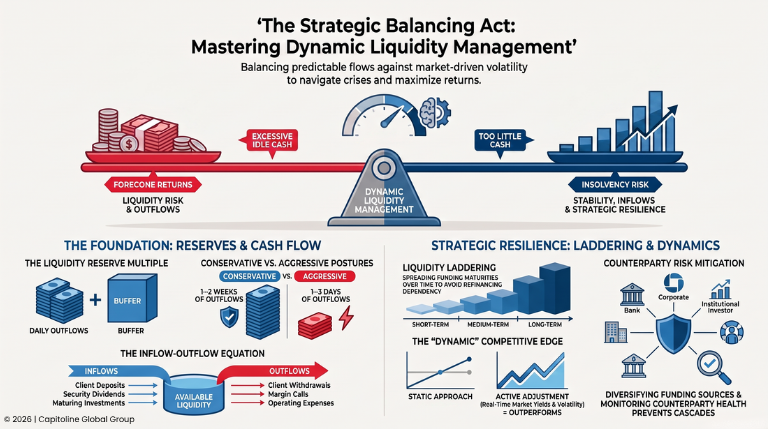
Liquidity management is the operational heartbeat of financial institutions. Too much cash sitting idle represents foregone returns. Too little liquidity creates risk: the inability to meet obligations when they come due, or worse, being forced to liquidate positions at bad prices to raise cash. The tension between maximizing returns on cash and maintaining sufficient liquidity to handle unexpected needs is a constant operational challenge.
In stable market environments, liquidity management is straightforward. You forecast cash flows, maintain enough liquid assets to cover them, and deploy excess cash to generate returns. When markets become volatile or stressed, the problem becomes far more complex. Cash flows become less predictable. Assets that were liquid become illiquid. Institutions that were comfortable borrowing to bridge short-term cash gaps suddenly can’t access borrowing markets.
Dynamic liquidity management—managing cash positioning actively in response to changing market conditions – is a capability that separates well-run institutions from those that experience liquidity crises.
THE SOURCES AND USES OF LIQUIDITY
Liquidity management starts with understanding where cash comes from and where it goes. Cash inflows include:
- Client deposits and capital contributions (for asset managers, this is the new money flowing in from investors)
- Interest and dividend payments from held securities
- Maturing investments and derivative payouts
- Sales of securities and derivatives
Cash outflows include:
- Client withdrawals and redemptions
- Operating expenses and compensation
- Paying margin calls or collateral requirements
- Purchasing new investments
- Funding loans and extensions of credit
For most institutions, both inflows and outflows are partially predictable (based on historical patterns) and partially uncertain (based on market conditions and client behavior). The challenge is managing the portfolio of inflows and outflows to ensure sufficient liquidity without excessive idle cash.
THE LIQUIDITY RESERVE CALCULATION
The starting point for dynamic liquidity management is calculating how much liquid assets you need to maintain. This is typically calculated as a multiple of expected daily outflows, plus a buffer for unexpected shocks.
A conservative institution might maintain reserves equal to 1-2 weeks of outflows. A more aggressive institution might maintain reserves equal to 1-3 days of outflows. The balance reflects the institution’s assessment of how likely a liquidity stress is and how severe it might be.
Stress testing is critical: what would cash outflows look like in a stress scenario? If there’s a market disruption that spooks investors, redemptions might spike 10x above normal levels. If the institution’s credit quality comes into question, even stable capital sources might evaporate. Stress tests should model these scenarios and ensure the liquidity reserve is sufficient.
Asset quality becomes critical during liquidity stress. Cash reserves should be in assets that remain liquid during stress. Government securities and central bank deposits remain liquid even during market disruptions. Corporate bonds, equities, and other less-liquid assets might not be saleable when you need them most.
LIQUIDITY LADDERING AND MATURITY MANAGEMENT
For institutions with funding costs (banks, mortgage originators), managing when liabilities mature is critical. Funding that matures today needs to be rolled over or the institution needs to have cash on hand to repay it. Funding that matures in a year can be addressed later.
Liquidity laddering spreads funding maturities over time so that the institution isn’t dependent on refinancing a large amount of funding in a single period. If all funding matures in 30 days, a one-month liquidity disruption creates a crisis. If funding is laddered so that 1/12 of it matures each month, a one-month disruption is manageable.
The challenge is managing this proactively: as funding reaches maturity, the institution needs to decide whether to roll it over, extend it, replace it with different funding, or reduce overall borrowing. These decisions need to be made before maturities arrive, not after.
DYNAMIC CASH POSITIONING
In normal markets, cash positioning is relatively static: maintain a target cash level, deploy excess cash to assets, raise cash as needed.
In volatile markets, active cash positioning becomes valuable. When yields on cash-like instruments (short-term deposits, money market funds) spike during stress, it becomes more valuable to hold cash. When yields on longer-term investments spike (indicating attractive valuations due to market stress), it becomes valuable to deploy cash.
A dynamic approach continuously evaluates the trade-off: what are the opportunity costs of holding excess cash versus the risks of being short on liquidity? As market conditions change, the optimal answer to that question changes.
Institutions with the infrastructure to implement dynamic cash positioning – systems that monitor cash flows, calculate optimal cash levels, and execute trades to adjust positioning – can consistently outperform institutions with static approaches.
COUNTERPARTY RISK AND LIQUIDITY CASCADES
One of the most significant liquidity risks occurs when liquidity stress at other institutions creates a cascade of forced actions that threaten your institution’s liquidity.
If a counterparty becomes stressed and needs to raise cash, they might sell assets you’re depending on for liquidity. If a funding source becomes stressed, they might withdraw deposits or reduce credit lines. If collateral counterparties raise margin calls, you need to post additional cash.
Managing counterparty risk requires:
- Monitoring counterparty financial health continuously, not just during formal reviews.
- Diversifying funding sources so dependence on any single source is limited.
- Maintaining relationships with multiple liquidity providers so that if one becomes unavailable, others can step in.
- Stress testing your exposure to counterparty failures and understanding what would happen if key counterparties failed.
TECHNOLOGY INFRASTRUCTURE FOR LIQUIDITY MANAGEMENT
Managing sophisticated liquidity positioning requires technology infrastructure that can:
- Aggregate cash positions across the institution, accounting for different currencies, time zones, and operating companies.
- Forecast cash flows based on historical patterns, current market conditions, and stress scenarios.
- Calculate optimal cash levels and identify when cash positioning is out of balance.
- Monitor counterparty exposures and funding stability.
- Execute liquidity transactions (borrowing, lending, repositioning assets) as needed.
- Provide reporting and alerts when liquidity positions approach risk limits.
Many institutions operate with fragmented systems: different business units managing their own cash, limited visibility into consolidated liquidity, cash pools maintained by geography or currency. This fragmentation makes dynamic liquidity management difficult.
Institutions with consolidated liquidity visibility – where a central team can see all cash positions, all funding sources, all collateral obligations – can manage liquidity more effectively.
COMPETITIVE POSITIONING IN LIQUIDITY MANAGEMENT
The cost of poor liquidity management is usually invisible until crisis strikes. But it’s real: institutions that are forced to liquidate positions at bad prices, or that have to pay premium rates for emergency funding, suffer material performance impact.
Institutions that manage liquidity dynamically, maintaining optimal positions that balance opportunity and safety, deliver consistently better returns. The edge isn’t dramatic in any single quarter, but it compounds over years.