
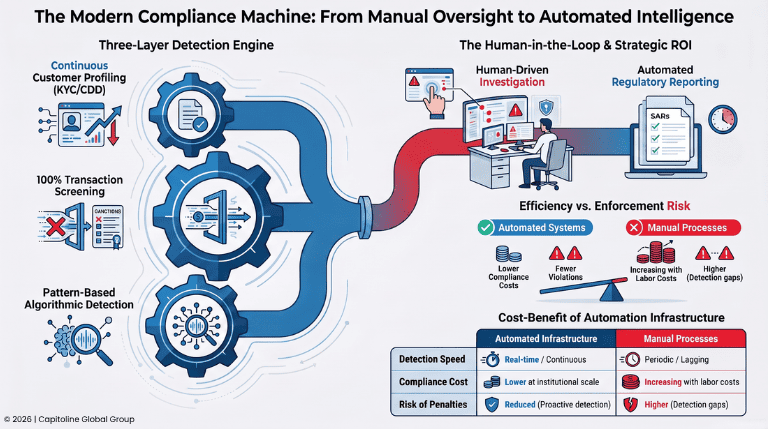
Compliance monitoring has evolved from a manual, periodic activity to a continuous, systematic process that uses automation to detect potential violations in real time. This evolution hasn’t been driven by regulatory generosity – regulators have consistently increased requirements and raised penalties for failures. It’s been driven by technology and economics: the cost of building compliance automation infrastructure has fallen to the point where it’s often cheaper than manual processes, while the cost of compliance failures has risen sharply.
The scope of compliance that financial institutions must manage has expanded dramatically. Beyond traditional AML/KYC requirements, institutions now monitor for sanctions violations, market manipulation, insider trading, conflicts of interest, suitability issues, and numerous regulatory reporting requirements. The volume of transactions, the velocity of trading, and the complexity of modern financial instruments make manual compliance monitoring impossible.
Institutions that have systematized compliance monitoring – automating detection while maintaining human judgment for investigation and resolution – operate at lower compliance cost and with fewer violations than those still relying on primarily manual processes.
BUILDING BLOCKS OF COMPLIANCE AUTOMATION
Compliance automation operates in layers, each targeting different types of violations.
Transaction monitoring screens every transaction – trade, payment, wire transfer, deposit, withdrawal – against compliance rules. Is the counterparty on a sanctions list? Does the transaction match a suspicious activity pattern? Is the customer trying to avoid reporting thresholds? Rule-based screening flags suspicious transactions for human investigation.
Customer due diligence systems maintain information on customers and counterparties, including beneficial ownership, source of funds, and business purpose. This information is used to:
Support initial onboarding decisions: should we accept this customer?
Determine risk rating: how much scrutiny does this customer’s activity need?
Detect changes in customer profile: has the customer’s business fundamentally changed?
Sanctions screening compares counterparties and customers against multiple sanctions lists (OFAC SDN list, EU sanctions, UN lists, etc.) continuously. As lists are updated, existing customers and counterparties are re-screened to identify newly sanctioned entities.
Know-your-customer (KYC) information is collected during customer onboarding and maintained throughout the relationship. The information includes personal identification, address verification, beneficial ownership, and source of funds for significant deposits.
The collection and maintenance of KYC information is increasingly automated: identity verification uses machine learning to validate identity documents, address verification uses geographic databases, beneficial ownership is traced through corporate registries.
Enhanced due diligence for high-risk customers involves additional steps: more frequent re-screening, deeper investigation of transaction patterns, management approval for new accounts.
Rules and algorithms that detect suspicious patterns. These include:
Structuring detection: multiple transactions just below reporting thresholds, suggesting an attempt to avoid reporting requirements.
Unusual activity patterns: transactions inconsistent with the customer’s normal activity.
Money laundering indicators: rapid movement of funds through multiple accounts, deposits followed immediately by withdrawals.
Trade surveillance: unusual trading patterns suggesting market manipulation, front-running, or insider trading.
Reporting systems that consolidate compliance exceptions, send them to investigators, track investigations to resolution, and produce regulatory reports.
CHALLENGES IN COMPLIANCE AUTOMATION
The primary challenge in compliance automation is false positives: flagging activity as suspicious when it’s actually legitimate. If compliance teams are buried in false positives, they become desensitized and might miss genuine violations.
Managing false positive rates requires continuously tuning rules and algorithms. As systems learn what legitimate activity looks like for specific customer segments, rules can be adjusted to reduce false alerts.
Another challenge is false negatives: not flagging activity that is actually suspicious. This is harder to detect – you don’t find out about false negatives until a compliance violation occurs that should have been caught. Monitoring false negative rates requires embedding test transactions or synthetic scenarios that should trigger alerts and confirming that they do.
Regulatory compliance requirement changes require updating rules and algorithms. A new regulation about beneficial ownership reporting might require changes to customer due diligence procedures and re-screening of existing customers. Institutions without systematic processes for making these updates across their compliance systems can fall behind rapidly.
Data quality is essential: if customer data is incomplete or inaccurate, compliance decisions based on that data are flawed. Many institutions struggle with maintaining data quality across legacy systems and multiple data sources.
INVESTIGATIONS AND RESOLUTION
Compliance automation flags suspicious activity, but it takes human judgment to determine whether flagged activity actually represents a violation. A sophisticated compliance function has investigators who:
Review flagged activity in context: is this pattern actually suspicious given what we know about the customer’s business?
Gather additional information: what was the customer’s stated purpose for this transaction? Are there legitimate business reasons for the pattern?
Make recommendations: based on the investigation, should this activity be reported to regulators? Should the customer be terminated? Should the transaction be blocked?
Document the investigation: maintaining clear documentation of the investigation process and conclusion is essential if regulators review compliance decisions.
The investigation process is often manual and time-consuming. Technology can help: by providing tools that let investigators gather and review information efficiently, by standardizing investigation workflows, by maintaining investigation records in searchable formats.
REGULATORY REPORTING
Compliance violations that meet reporting thresholds must be reported to regulators. The most common reports are:
SARs (Suspicious Activity Reports) in the US, reported to FinCEN when suspicious activity is detected.
CTRs (Currency Transaction Reports) reported when large cash transactions occur.
AMLC reports and similar reports in other jurisdictions.
Sanctions violation reports to OFAC when violations are detected.
Market abuse reports to FINRA or other market regulators.
These reports must be filed within specific timeframes (SARs within 30 days of detection) and contain detailed information about the activity, the investigation, and the institution’s decision. Generating these reports accurately and on time requires systems that track exceptions and investigations from detection through final reporting.
THE COST AND BENEFIT CALCULATION
Building compliance automation infrastructure is expensive and requires ongoing investment. It requires specialized staff, ongoing rule and algorithm updates, and integration with trading, operations, and customer systems.
But the benefits are substantial:
Reduced violations: systematic detection reduces the number of violations that go undetected.
Reduced penalties: when violations are detected internally, they can often be reported to regulators and corrected before becoming enforcement actions.
Reduced compliance cost: automated detection and investigation is cheaper than entirely manual processes at institutional scale.
Reduced operational disruption: compliance exceptions that are handled efficiently don’t create bottlenecks in trading and operations.
The net benefit is usually strongly positive: institutions that have invested in compliance automation have better compliance outcomes at lower cost than those that haven’t.
COMPETITIVE POSITIONING
Compliance infrastructure is often invisible to clients and markets. But it’s critical to institutional reputation and regulatory standing. Institutions with poor compliance track records face regulatory scrutiny, enforcement actions, and reputational damage.
Institutions with strong compliance infrastructure – demonstrated by low violation rates and proactive regulatory engagement – build trust with regulators and clients. This is a source of competitive advantage that translates to business opportunities and lower regulatory costs.