
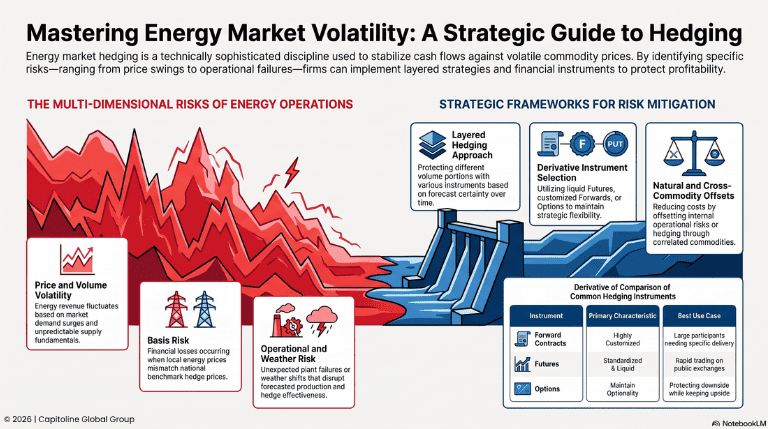
Energy market hedging is one of the most technically sophisticated and strategically important applications of financial derivatives. Unlike equities or bonds, where price risk is the primary concern, energy markets present a complex array of risks: price risk, volume risk, basis risk, and operational risk. Hedging these risks effectively requires sophisticated understanding of the underlying markets, the structure of available hedging instruments, and the specific risk profile of the operation being hedged.
The stakes are significant. For energy companies, financial institutions with energy exposure, and trading operations, poor hedging can erase years of profitable operations in a single bad market move. Conversely, effective hedging can stabilize cash flows and enable strategic decisions that wouldn’t be possible without hedging protection.
THE RISK STRUCTURE OF ENERGY OPERATIONS
Energy operations are exposed to multiple distinct risks that often move independently. Understanding each risk separately is the foundation for effective hedging strategy.
Price risk is the most obvious: the cost of energy will move based on supply and demand fundamentals, geopolitical events, weather, and numerous other factors. A power generator sells electricity at a price determined by wholesale market prices. If those prices fall, revenues fall. If they rise, revenues rise. The risk is that prices fall unexpectedly and damage profitability.
Volume risk is equally important but often overlooked. The amount of energy sold isn’t fixed – it depends on demand, which is driven by weather. On hot days, electricity demand surges. On cold days, it surges for heating. A power generator doesn’t control demand; it just produces to meet it. But for hedging purposes, this creates risk: if the forecasted demand is wrong, the forecasted volume of sales is wrong, and the hedge which assumed a certain volume now has too much or too little protection.
Basis risk arises from price differences between locations or delivery periods. A power generator in one location produces electricity with value equal to the local wholesale price. That local price might differ from the national benchmark price. A hedge using national benchmark prices doesn’t perfectly protect against local price movements.
Operational risk is the risk that production doesn’t occur as planned. A power plant might fail unexpectedly. A transmission line might be unavailable. Weather might prevent wind generation or solar generation from occurring as forecast. These operational disruptions affect volume available for sale and create mismatches between hedges and actual production.
HEDGING STRATEGY FRAMEWORKS
Effective energy hedging requires a strategic framework that addresses each risk explicitly.
The most common approach is layered hedging: protecting different portions of forecasted volume with different instruments and time horizons. Current month exposure might be hedged 100% with forward contracts, locking in prices. The next three months might be hedged 75% using options (providing downside protection while maintaining upside), with the remaining 25% unhedged to allow participation if prices move favorably. Further out horizons might be hedged with smaller percentages, allowing flexibility as forecasts become more certain.
This layered approach reflects the evolution of forecast confidence: the further you are from the current date, the less certain the forecast, so applying less rigid hedges that maintain optionality makes sense.
Natural hedging is the practice of offsetting risks within the operation itself. A power generator that also has a gas supply contract might use the gas contract price movements as a hedge for the electricity sale. The two aren’t perfectly correlated, but they move together, providing partial natural hedging. This is more efficient than using derivatives to hedge both components separately.
Cross-commodity hedging uses the fact that some commodity prices are correlated. Power prices and natural gas prices are correlated (because many plants burn natural gas to generate power). By holding the right mix of gas positions, a power generator can hedge electricity price risk without using electricity futures. This approach requires sophisticated understanding of correlations and works well when correlations are stable.
THE INSTRUMENTS AVAILABLE FOR ENERGY HEDGING
Forward contracts are the most basic hedging instrument: agreement to buy or sell energy at a fixed price for delivery at a specified future time. Forwards are customized to the specific location, volume, and timing required, but they lack liquidity – there’s no public market where forwards trade. Forwards are used mostly by large participants who can negotiate directly with dealers.
Futures are standardized forwards that trade on exchanges. They’re liquid – you can buy and sell futures quickly – but they’re standardized, so they don’t match every hedging need perfectly. A power generator might need to hedge volumes for a specific location. The available futures contracts might be for a different location or time period. This creates basis risk: the futures hedge doesn’t perfectly match the exposure being hedged.
Options provide hedging that maintains optionality. A put option gives the right to sell at a fixed price while keeping upside if prices move favorably. A call option gives the right to buy at a fixed price while maintaining downside benefit if prices fall. Options cost money (the premium) but provide asymmetric payoff: protection in one direction while maintaining benefit in the other. For many energy hedging applications, options are more appropriate than forwards because they preserve strategic flexibility.
Swaps exchange cash flows based on price movements. A power seller might enter a swap where they exchange floating-price revenue from electricity sales for fixed-price revenue. The power producer gets certainty about cash flow; the swap counterparty gets the variable exposure the producer wanted to shed.
INFRASTRUCTURE FOR ENERGY HEDGING
Implementing energy hedging at institutional scale requires sophisticated infrastructure. This includes:
Market data for all relevant energy commodities and related indexes (crude oil, natural gas, electricity, coal) in all relevant locations and time periods. Pricing needs to be real-time for current periods and predictive (forward curves) for future periods.
Position tracking systems that monitor hedged volumes and unhedged volumes separately, allowing visualization of what portion of forecasted production is protected at each time horizon.
Cash flow forecasting systems that project energy production and usage based on historical patterns, weather forecasts, and operational constraints.
Execution infrastructure for transacting derivatives: whether through futures markets, over-the-counter dealers, or internal derivative operations.
Risk management systems that monitor hedge ratios (what percentage of forecasted volume is hedged), basis risk (the mismatch between the hedge and the underlying exposure), counterparty risk (credit quality of dealers providing hedges), and mark-to-market value of open hedges.
Accounting infrastructure that applies hedge accounting (allowed under financial reporting rules), which requires documenting the hedging relationship and confirming that the hedge is effective in offsetting risk.
THE COMPETITIVE REALITY
Energy hedging is a source of competitive advantage for operations that execute it well. Better forecasts of production volume, more sophisticated hedging strategies, and more active management of hedge ratios as circumstances change all translate to more stable revenues and lower cash flow volatility.
This is why large energy companies maintain sophisticated hedging operations with dedicated teams, trading infrastructure, and risk management discipline. The cost of this infrastructure is justified by the value it creates: stabilizing cash flows in volatile commodity markets.
For smaller operations without the scale to justify building full hedging infrastructure, partnerships with larger firms or use of commodity hedging service providers can provide similar benefits.