
The most consequential operational events in digital asset businesses tend to be custody-related. When a custodian loses client assets, the business typically ceases to exist, regardless of how profitable it was before. The risk is binary: either custody works or it doesn’t. There’s no meaningful middle ground.
This reality has driven institutional digital asset custodians to build infrastructure and governance frameworks that are more rigorous than those in many traditional financial services contexts. Understanding what that infrastructure looks like – and why each component exists – is essential for any institution considering whether to deploy capital in digital assets.
THE FUNDAMENTAL CHALLENGE OF DIGITAL ASSET SECURITY
The core challenge with digital assets is that security and operational control exist in tension. Traditional financial assets – equities, bonds, cash – exist as ledger entries in custodian systems. Security comes from access controls on those systems: physical security of data centers, network security, authentication protocols, encryption. The ledger itself is the asset.
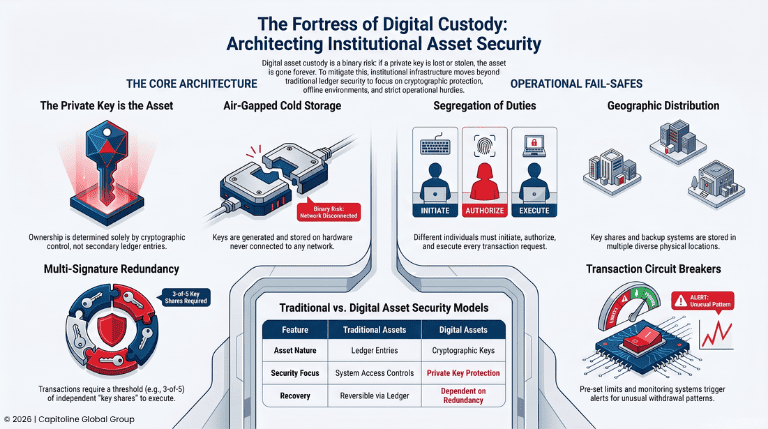
Digital assets, by contrast, are owned by whoever has cryptographic control of the private key. The security model is fundamentally different: the asset is the key. If you have the key, you own the asset. If you lose the key, the asset is gone. If someone else controls the key, they control the asset, and no amount of ledger entries can change that.
This creates an operational dilemma: the custodian needs to maintain the private key in a way that:
It can be accessed whenever the customer authorizes a transaction.
It can never be accessed by anyone not authorized by the customer.
It’s protected against loss through theft, hardware failure, or other operational catastrophes.
It can be recovered if the person(s) who control it become unavailable.
Solving this requires infrastructure and protocols that balance all four requirements simultaneously.
COLD STORAGE AND OFFLINE SECURITY
The most fundamental element of institutional digital asset custody is cold storage: keeping the vast majority of customer assets offline, not connected to any network.
The security advantage of cold storage is straightforward: assets that aren’t connected to the internet can’t be remotely hacked. Even if an attacker compromises the custodian’s network infrastructure, the offline-stored assets remain secure. The trade-off is that cold storage assets take longer to access – they can’t be transferred immediately – and require careful procedures to ensure that the offline environment itself doesn’t become compromised during access events.
The most rigorous cold storage implementations use air-gapped environments: computers that have never been connected to any network and are kept in that state. Private keys are generated in the air-gapped environment, stored on hardware that never leaves that environment, and accessed only when necessary for authorized transactions.
The physical security requirements for cold storage are significant. The hardware containing the keys must be protected against theft, physical tampering, and environmental damage. High-value custodians maintain multiple geographic locations, each with its own environmental controls, physical security, and restricted access protocols.
MULTI-SIGNATURE ARCHITECTURE
A single point of failure in custody is unacceptable. If one person or system controls the private key, their compromise means complete loss of customer assets. Multi-signature architecture addresses this by requiring that transactions be authorized by multiple independent parties.
In multi-signature schemes, a private key is split into multiple pieces (shares) that are distributed to different individuals or secured in different physical locations. A transaction requires that a threshold number of shares – perhaps 3 out of 5 – be brought together to reconstruct the key and authorize the transaction. No single individual or system has complete control.
The governance of multi-signature schemes is critical. The key decision is the threshold: how many signatures are required to authorize a transaction. A low threshold (1 of 3) makes operations efficient but introduces single-point-of-failure risk. A high threshold (5 of 5) eliminates single points of failure but makes operations inflexible if a key holder becomes unavailable.
The best institutional practices use thresholds that balance these concerns – often 2 of 3 or 3 of 5 and maintain redundancy to ensure that key holders don’t become unavailable simultaneously.
SEGREGATION OF DUTIES AND OPERATIONAL CONTROLS
Beyond the cryptographic architecture, institutional custody requires operational controls that prevent unauthorized transactions from occurring even if private keys are compromised.
Segregation of duties requires that no single person controls the entire transaction approval process. The person who initiates a withdrawal request is different from the person who authorizes it. The person who authorizes it is different from the person who executes it. If any single person is compromised, they can’t unilaterally move customer assets.
Transaction approval workflows require that all withdrawals above certain thresholds go through explicit approval processes. A customer requests a withdrawal, the request is reviewed for legitimacy, and – if approved – the transaction is authorized and executed. The review step catches attempts to move assets in unusual ways or to unauthorized addresses.
Limits on individual transactions provide a circuit breaker against catastrophic losses. Even if an attacker gains partial control of the system, transaction limits constrain what they can move in a single transaction or within a time period. This buys time for detection and response.
Monitoring and alerting systems continuously review transaction activity for patterns that deviate from normal: large withdrawals, transfers to new addresses, transfers outside normal business hours. These alerts trigger investigation before transactions complete, in many cases preventing unauthorized transfers from finishing.
DISASTER RECOVERY AND BUSINESS CONTINUITY
Custody operations must continue to function even when primary systems or locations fail. This requires carefully architected disaster recovery and business continuity planning.
Backup systems in geographically diverse locations ensure that if a primary location becomes unavailable – through natural disaster, power failure, physical attack, or any other cause – the backup can continue to serve customers. The backup systems need to be kept current with transaction activity on the primary systems, requiring real-time synchronization infrastructure.
The disaster recovery plans need to be tested regularly. A plan that looks good on paper but has never been tested in reality is often useless when an actual emergency occurs. Institutional custodians conduct regular disaster recovery exercises to confirm that failover systems work, that data is current, and that operational staff can execute emergency protocols.
REGULATORY COMPLIANCE AND CUSTOMER ASSET PROTECTION
Custody infrastructure must be designed to support regulatory compliance. In most jurisdictions, regulators require that custodians segregate customer assets from the custodian’s own assets. If a custodian fails or becomes insolvent, customer assets are protected and continue to exist, even if the custodian’s own assets are seized.
This legal segregation is supported by operational processes: assets are held in accounts or structures that legally belong to customers, not the custodian. Accounting and reconciliation systems track ownership precisely. Regular audits confirm that customer assets are actually held and haven’t been fraudulently claimed.
For digital assets, this legal segregation is complicated by the fact that the blockchain only shows the custody address as the owner, not the individual customer names. Custodians maintain off-chain records that document which blockchain address belongs to which customer, but the blockchain itself doesn’t reflect this. This creates an additional layer of risk: if the custodian’s records become corrupted or lost, proving who owns what becomes difficult.
THE COMPETITIVE REALITY
Building institutional-grade digital asset custody is expensive and complex. It requires capital investment in infrastructure, security, and operational systems. It requires hiring specialists in cryptography, operational security, and regulatory compliance. It requires ongoing investment in security audits, system monitoring, and disaster recovery testing.
This is precisely why it’s a source of competitive advantage. Firms that have built this infrastructure have created a genuine moat around their business. Competitors that try to cut corners – using less secure storage, weaker operational controls, minimal redundancy – are gambling with customer assets in a way that sophisticated institutions won’t accept.
The timeline for building this capability is measured in years, not months. Institutions that are serious about digital asset custody are making that investment today, understanding that the payoff comes from being the trusted custodian that institutional investors are willing to work with.