
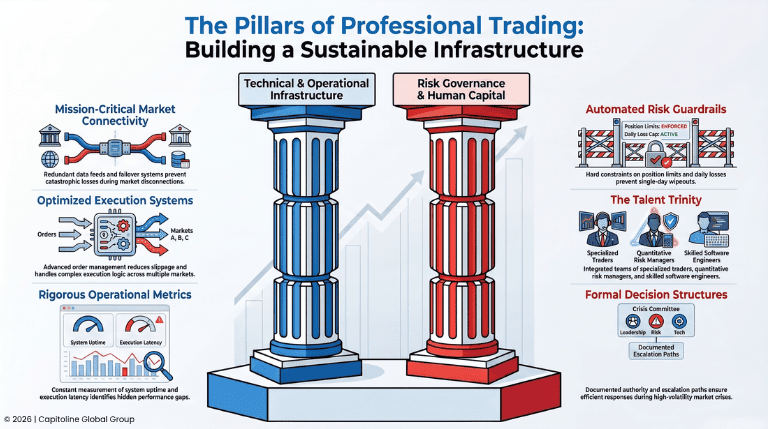
Starting a professional trading operation is more complex than many aspiring traders appreciate. The assumption is often that trading success comes down to good strategy and disciplined execution. Those are necessary, but they’re not sufficient. Professional trading operations require infrastructure, talent systems, and operational discipline that are often invisible to external observers but absolutely critical to consistent performance.
The firms that build sustainable, profitable trading operations have typically made deliberate investments in infrastructure and operational processes that extend well beyond the trading logic itself. Understanding what that looks like – and why it’s essential – is the foundation for building anything more than a hobby trading operation.
THE MARKET CONNECTIVITY INFRASTRUCTURE
Before a single trade can be executed, connectivity must be established to the markets where trading will occur. This sounds straightforward but is actually complex.
Exchange connectivity requires establishing accounts with each market where the firm wants to trade. This involves legal paperwork, compliance review, capital requirements, and proving operational competence to the exchange. The process can take months for new firms, particularly those seeking direct market access or algorithmic trading permissions.
Data feed infrastructure requires subscribing to real-time market data from one or more data vendors and managing the technical connectivity to ingest that data. This includes handling feed failures, buffer management, synchronizing clocks across systems, and storing historical data for backtesting and audit trail purposes.
The connectivity infrastructure needs to be reliable. A trading system that’s connected to markets most of the time but has frequent disconnections is worse than useless – it creates systematic losses as positions are entered during connections and then stuck unhedged during disconnections. Successful operations treat connectivity as a critical service that requires monitoring, alerting, and failover systems.
Many trading operations maintain backup connectivity to critical markets: if the primary connection fails, secondary connections kick in automatically. This redundancy costs money but is cheaper than the losses that come from being disconnected during important market moves.
EXECUTION SYSTEMS AND ORDER MANAGEMENT
Once data flows in and the decision to trade has been made, orders need to be submitted to the market reliably and efficiently. This requires execution systems that can:
Convert the high-level decision (“buy 100 contracts”) into market orders with appropriate sizing, timing, and execution logic.
Submit orders to the market(s) where liquidity is available, handling multiple counterparties if necessary.
Monitor execution to confirm that orders have been filled, rejected, or partially filled as expected.
Handle execution failures gracefully: retrying if a submission fails, canceling if necessary to prevent unintended trades.
The specifics of order management depend on the assets being traded. Equity and futures traders might use algorithmic execution algorithms that slice large orders into smaller pieces to minimize market impact. Bond traders might request quotes from multiple dealers and then execute with the most attractive dealer. Crypto traders might route orders across multiple exchanges to access liquidity.
The quality of execution infrastructure directly affects trading performance. A system that executes with minimal slippage and fast latency is a competitive advantage. One that regularly experiences delays, partial fills, or unnecessary rejections is a competitive liability.
RISK MANAGEMENT SYSTEMS AND OPERATIONAL CONTROLS
Alongside market systems, professional trading operations require robust risk management. This starts with position limits: hard constraints on how much capital can be deployed to any position, sector, or asset class.
Daily loss limits ensure that a single bad day doesn’t wipe out the trader or the firm. If losses reach the daily limit, all discretionary trading stops. The goal is to minimize the damage from days when the market moves against your positions in unexpected ways.
Counterparty limits ensure that no single counterparty (prime broker, clearing firm, etc.) is carrying excessive exposure to the firm. If a counterparty fails, the firm shouldn’t be catastrophically damaged.
Real-time position tracking ensures that the trading system always knows what the firm currently owns, what it’s committed to buying or selling, and what the current market value of positions is. Intraday profit and loss (P&L) tracking lets traders monitor how they’re performing throughout the day.
Order entry controls prevent erroneous orders from being submitted. A trader shouldn’t be able to accidentally submit an order that’s 10x larger than intended, or to the wrong market. Systems should validate orders before submission and require confirmation for large or unusual trades.
Trade reconciliation compares the firm’s records of what it traded with the counterparties’ records. Discrepancies are investigated and resolved before they become bigger problems.
TALENT AND EXPERTISE
Professional trading operations require skilled people: traders who understand markets, risk managers who understand portfolio risk, technologists who can build and maintain systems, and operational staff who manage the day-to-day execution.
Traders need specific expertise in the markets where trading occurs. Energy traders need to understand the power markets, fuel derivatives, and transmission constraints. Crypto traders need to understand blockchain fundamentals, exchange operations, and digital asset custody. The specificity matters: a talented trader from another market might be able to learn, but the learning curve is real.
Risk managers need quantitative skills and deep understanding of financial risk. They need to be comfortable challenging traders when positions are getting too large or correlations are creating hidden concentrations. In immature risk cultures, risk managers are often overridden. In mature cultures, they’re respected as critical to the operation’s long-term survival.
Technologists are increasingly critical. Building execution systems, maintaining real-time data feeds, monitoring connectivity, troubleshooting issues – these all require skilled engineers. The difference between a well-engineered trading system and a fragile one shows up in performance reliability.
Operational staff manage compliance, regulatory reporting, client communications, and reconciliation. They’re often invisible to the bottom line until something goes wrong, at which point their work becomes dramatically visible. Operations quality is a major determinant of whether a firm passes regulatory examination.
ORGANIZATIONAL STRUCTURE AND DECISION-MAKING
Professional trading operations need clear decision-making structures. Who decides whether to enter a trade? Who has authority to spend capital? Who can override or reverse a trade? What are the escalation paths if something goes wrong?
These shouldn’t be left informal. Firms that have to pause to figure out who has authority during a market crisis are creating unnecessary risk. Decision-making authority should be clearly documented and understood.
The balance between centralized and distributed decision-making matters. A completely centralized structure where one person makes all decisions doesn’t scale. A completely distributed structure where everyone makes independent decisions creates coordination problems. Successful operations find a middle ground that allows for efficient decision-making while maintaining oversight and risk control.
OPERATIONAL METRICS AND PERFORMANCE TRACKING
Professional trading operations measure themselves rigorously. Trading performance is tracked: what returns were achieved relative to what was risked. Operational metrics are tracked: how reliable was system uptime, how fast were orders executed, how many errors occurred.
The measurement serves multiple purposes. First, it identifies problems. If execution latency is increasing or system downtime is increasing, the metrics flag it. Second, it drives improvement. What gets measured gets improved. Third, it creates accountability: traders know their performance is being tracked, risk systems know their effectiveness is being evaluated.
THE COMPETITIVE CONTEXT
Building a professional trading operation requires investment. The infrastructure costs money, hiring skilled people costs money, and supporting systems cost money. For small operations with limited capital, these costs can be prohibitive.
This is precisely why it’s a source of competitive advantage. Trading operations that have built professional infrastructure systematically outperform those that are still operating with ad-hoc systems and minimal governance. The performance gap isn’t dramatic in any single trade, but it compounds over years. The firm with better infrastructure, better systems, better risk management, and better execution quality will eventually leave the other firm far behind.